· 3 min read
Cognitive diversity, user groups, and the adjacent possible
I recently finished Rebel Ideas by Matthew Syed, and if I’m honest, it’s one of those books where you’re halfway through thinking: I already knew this somehow. The central argument isn’t complicated. Cognitive diversity: bringing together people with genuinely different backgrounds, experiences, and ways of thinking, is essential for solving hard problems. The main point it makes is how groups of highly capable, like-minded people can become collectively blind to problems that an outsider would spot immediately. It’s not about intelligence. It’s structural. When everyone operates from the same frame, they share the same blind spots.
Diverse input doesn’t automatically lead to better answers. But the odds are better.
Reading that, I immediately thought of Diwug, PowerAddicts and CollabdaysNL. These aren’t networking events I help organize or attend for leads or for the drinks. I go because the people who present and show up there sit in a slightly different part of the world than I do.
That might sound abstract. It’s actually very concrete. You’re in a room with a mix of developers, functional consultants, architects, and people who just use a tool daily for something specific. And then someone presents a use of a feature you already know, or not, but in a way you’d never considered. Not radically different. More what scientists call the adjacent possible. It sits just outside what you already know. Close enough to understand, far enough to shift your thinking.
That’s where the value is for me. Not every session leads to a direct application in a project. But fairly regularly there’s one moment in an evening where I think: wait we could actually use that for the problem we’ve been stuck on for weeks. That moment would never have happened behind my own screen, or just a working on a new proposal and you remember a tidbit of information on how focussing on the soft side of projects can help mitigate risks.
If you only talk to people using the same stack, serving the same type of clients, working from the same frame, you mostly confirm what you already thought. That feels efficient. But it makes you vulnerable. Because the hard problems are precisely the problems your existing patterns don’t solve. I’m not saying you should go network for networking’s sake. But if you deliberately choose environments where people with different backgrounds present on technology you simply increase the chance of running into something that usefully disrupts your thinking.
It depends on what you’re looking for, of course. But if you work in a field that moves as fast as ours and let’s be honest, AI only increased that speed, cognitive diversity isn’t a luxury. It’s just good risk management.
AI is here to stay. But the way it delivers the most value in your specific context? You won’t find that alone. You find it in conversation with people who ask just slightly different questions than you do, so perhaps we can meet at one of the user groups or conferences in the next few months 👋.
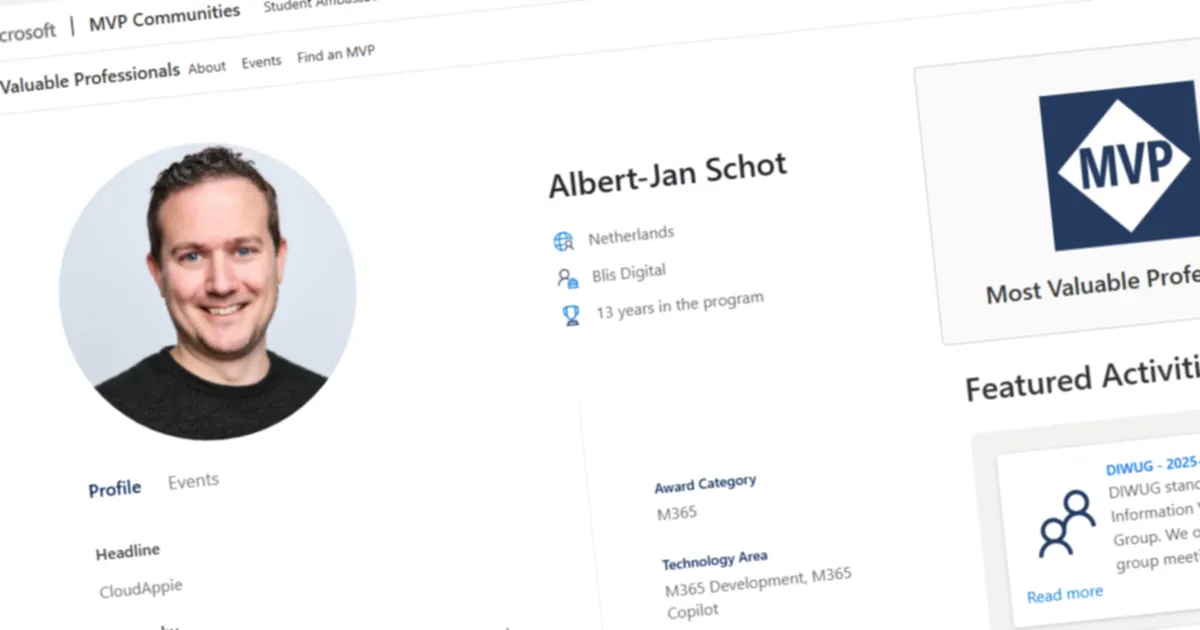
Albert-Jan Schot
CTO, Microsoft MVP & FastTrack Recognized Solution Architect
I am Albert-Jan Schot, CTO at Blis Digital, Microsoft MVP, and FastTrack Recognized Solution Architect focused on Microsoft 365, Azure, and AI agents. I help teams turn complex Microsoft Cloud challenges into practical architecture decisions and shipped outcomes.
Zuid Holland, Netherlands